Learn
Whatever a plant gets, it gets through the soil.
This is the long version. What organic matter actually does underground, why a soil can test adequate and still grow poorly, what a soil test can and can't see — and, at the end, exactly where BioBenefits™ sits in that picture and what we refuse to claim about it.
First principle
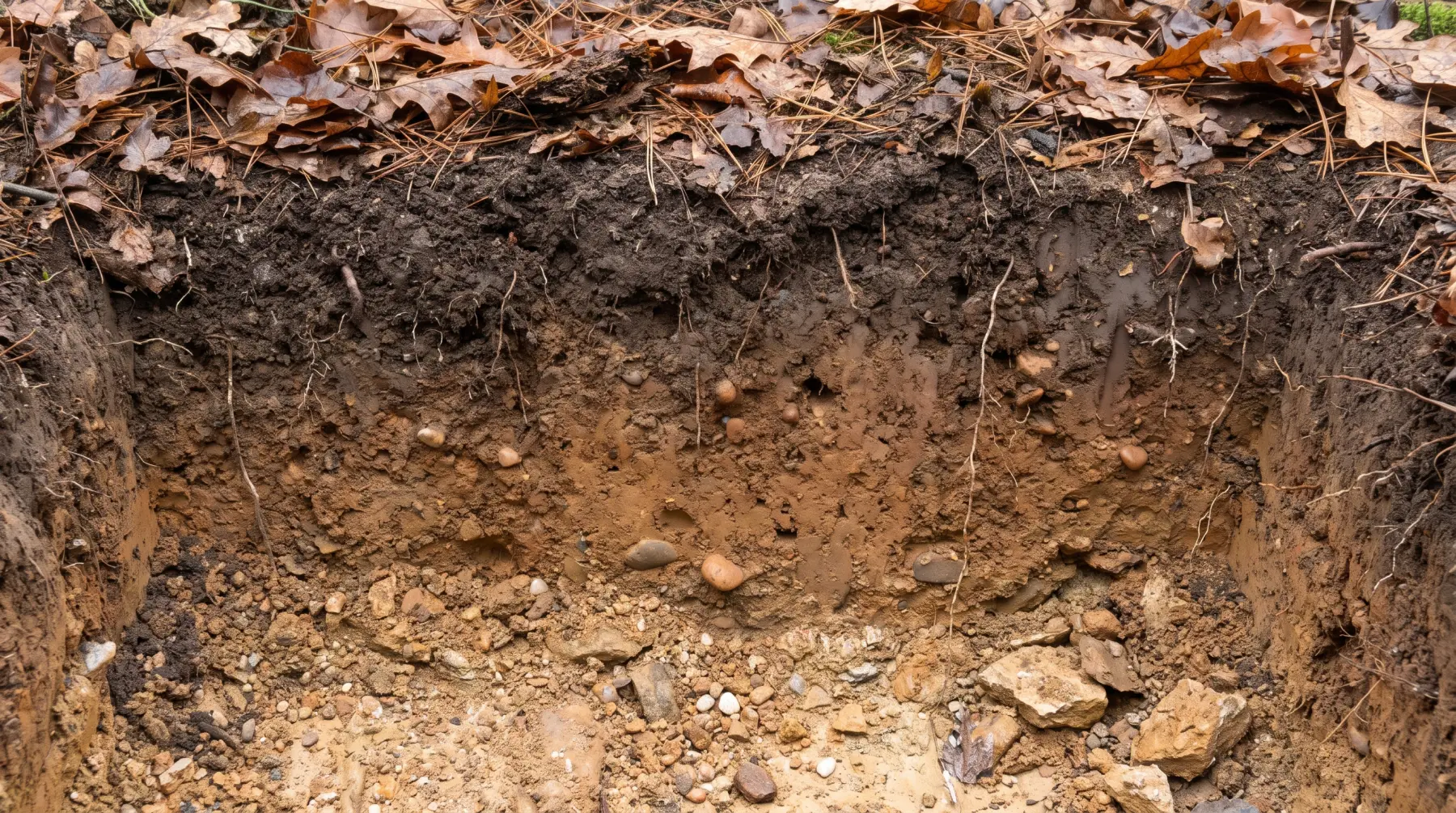
Humus is not plant food. It's the system that feeds plants.
If you take one idea from this site, take this one.
“Humus is good for soil” is one of the most repeated claims in gardening, and one of the least explained. So let's be precise about it.
Humus is not a nutrient source the way a nitrogen or phosphate fertilizer is. Plants don't take it up in quantity. What it does is set up the conditions in which nutrients become available, stay put, and keep circulating.
If fertilizer is the meal, humus is the digestive and circulatory system that decides how much of that meal ever reaches the plant.
That distinction matters commercially, too. It's the reason a soil can test adequate in nutrients and still grow poorly — and the reason feeding harder rarely fixes it. If the limiting factor is that nutrients wash past the root zone, or that the ground is too compacted for roots to reach them, or that nothing is alive down there to cycle them, then adding more of what is already sufficient changes nothing except your input bill.
The Science
Three jobs humus does in soil
None of them are glamorous. All of them decide your season.
A chemical sponge
Humic substances carry carboxyl (–COOH) and phenolic hydroxyl (–OH) groups, which are negatively charged at soil pH. They attract and hold cations — potassium (K+), calcium (Ca2+), magnesium (Mg2+), ammonium (NH4+).
This is cation exchange capacity, or CEC. Sandy soils are low in CEC, so nutrients leach straight through. As organic matter rises, CEC rises, and the soil holds more of what you give it.
Held is the operative word. These cations are not locked away — they sit on the exchange sites and swap off into the soil solution as roots draw the solution down. A sponge, not a safe.
A structural binder
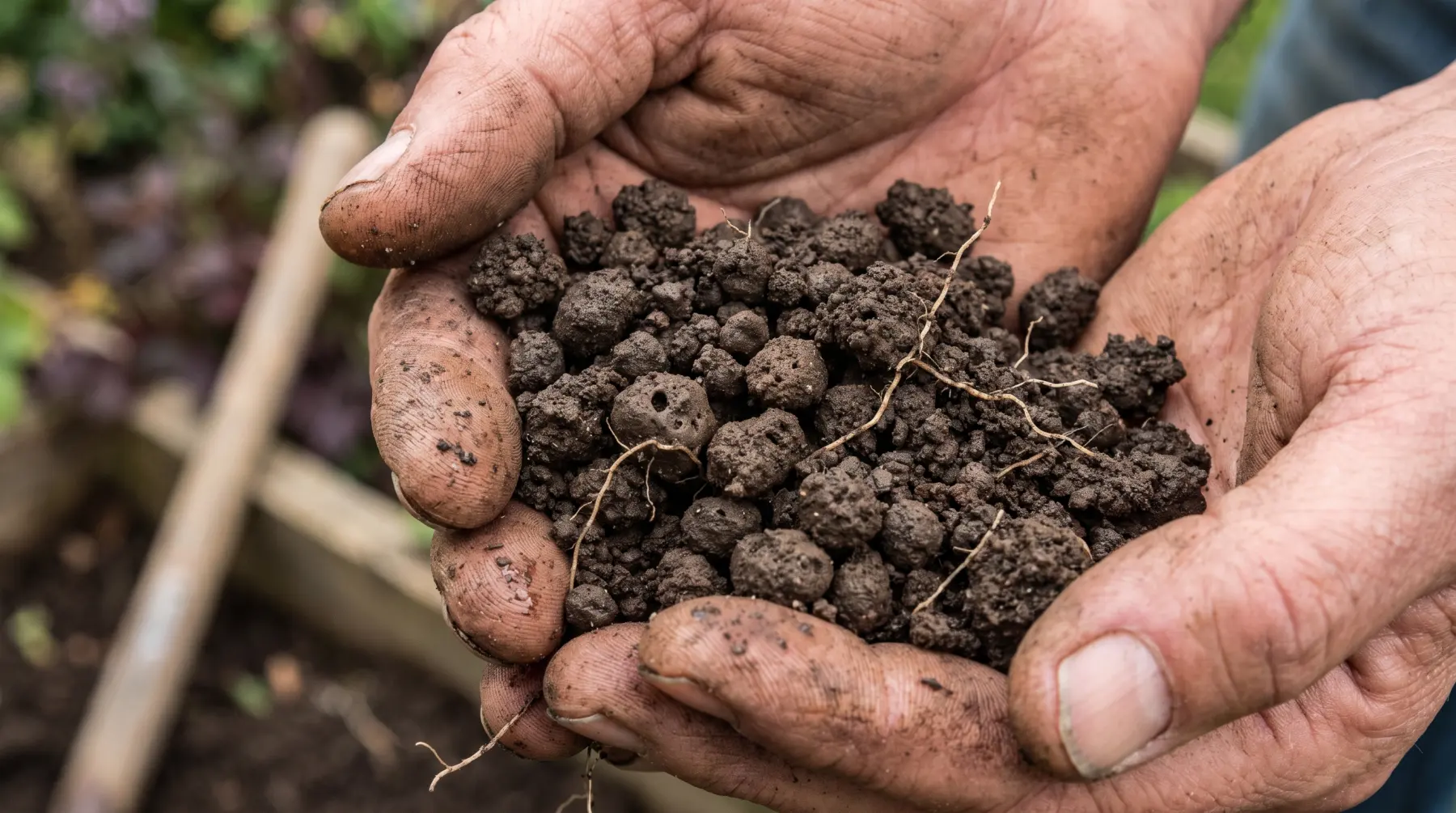
Humus binds clay particles, microbes and fungal hyphae together into aggregates — the crumbs you can see and feel in good soil.
Aggregated soil resolves what sounds like a contradiction: it drains freely and holds water, while staying open to air. Nutrient retention alone won't grow a crop if the soil is compacted or anaerobic.
The two happen at different scales. Water is held inside the crumbs, in pores fine enough to resist gravity; excess water and air move between them, in the larger channels the crumbs leave when they pack against each other.
A habitat
For bacteria, actinomycetes, mycorrhizal fungi and filamentous fungi, humus is shelter, energy source and buffer at once.
Which is why it's fair to call humus the infrastructure of the soil ecosystem — the thing the biology is built on rather than the thing it consumes.
And the relationship runs both ways. Fungal hyphae and microbial glues are part of what holds aggregates together, so the habitat is partly built by its own residents. Lose the biology and the structure degrades after it.
How the thinking changed
Modern soil science moved the arrow.
The older picture ran from humus straight to the plant. The working model today runs through the soil, not around it — and that single change is why “how much organic matter do I have” turns out to be a less useful question than “what is it doing.”
The older view
Humus feeds the plant. Add more of it and the plant gets more.
The current view
- Soil structure
- Microbial life
- Nutrient cycling
Humus builds and maintains the system that feeds the plant. Every route to the plant runs through the soil.
The practical consequence is that organic matter is a slow, indirect input with compounding returns, not a fast one with a dose response. It is also why the three jobs above cannot be substituted for one another. A soil rich in exchange sites but structureless still drowns; a soil with beautiful crumb and no biology still stalls.
In practice
What a soil test sees — and what it misses
What gardeners and growers actually notice is almost never a number on a soil test. It's crumb, moisture, and how the ground works under a fork.
A soil test is a chemical inventory, and a good one. It was simply never designed to tell you how your soil behaves.
What a standard test reports
- pH, and often a buffer pH giving a lime requirement
- Extractable phosphorus, potassium, calcium, magnesium, sulfur and micronutrients — pulled out with a laboratory reagent such as Mehlich-3, Bray or Olsen, chosen to suit the soils of your region
- Cation exchange capacity, usually calculated by summing those cations rather than measured directly
- Organic matter as a percentage, usually by loss-on-ignition
- Soluble salts, as electrical conductivity
What it does not report
- Whether water soaks in or ponds on the surface
- Whether the soil breaks into crumbs or lifts in slabs when you turn it
- How deep roots get before they turn sideways
- How much biology is present and active, unless you specifically order a biological assay
- How quickly the ground warms and dries in spring, and how long it stays workable after rain
An extractant is a proxy, not a measurement of what the root gets
Reagents like Mehlich-3 were adopted because, across a great many field trials, the amount they pull out of a shaken sample correlates usefully with how much a crop takes up. That correlation is real and worth having. It is still a correlation. A root operates in a much smaller, wetter, more crowded space than a test tube, over months rather than minutes, and with a rhizosphere chemistry it partly creates itself.
Why “organic matter %” alone is a weak target
It is the number everyone quotes, and on its own it carries less information than people expect.
It is a stock, not a flow. Two soils both reading 3% can behave quite differently depending on where that carbon sits. Fresh particulate residue is turning over now and feeding the biology now. Older material bound onto mineral surfaces is far more stable, holds water and cations well, and releases very little. The percentage does not distinguish them.
It moves slowly. Under ordinary management, the year-on-year change is small relative to the variation you get from sampling and from the lab. A one-year difference is often noise. Organic matter percent is a decade-scale indicator being used as a season-scale scorecard.
Loss-on-ignition is not clean. Heating also drives off water held within clay minerals, so clay-heavy soils read high, and labs correct for it with regressions that differ from lab to lab. Comparing a number from one lab against a number from another is not comparing like with like.
The same percentage does different work in different textures. In a sand, organic matter may supply most of the cation exchange capacity and most of the water held at tensions a root can use. In a heavy clay, the mineral fraction already provides both, and organic matter's largest contribution is structural — keeping the thing open.
None of which makes soil testing pointless. Test, and keep testing. Just read it for what it is: an inventory of the pantry. It cannot tell you whether the meal is being digested.
Our Approach
Most humic products bring you the humus. We looked at what moves through it.
This is the one technical difference worth understanding about BioBenefits™, and it's a difference of thinking, not just of process.
Conventional humic products
The line ends. A deposit is a finite thing you take from.
The idea: find humus, then pull one specific component out of it.
BioBenefits™
The loop keeps turning. We draw from a cycle that renews itself.
The idea: look at the part of the humus cycle that is actually in motion.
What “in motion” means
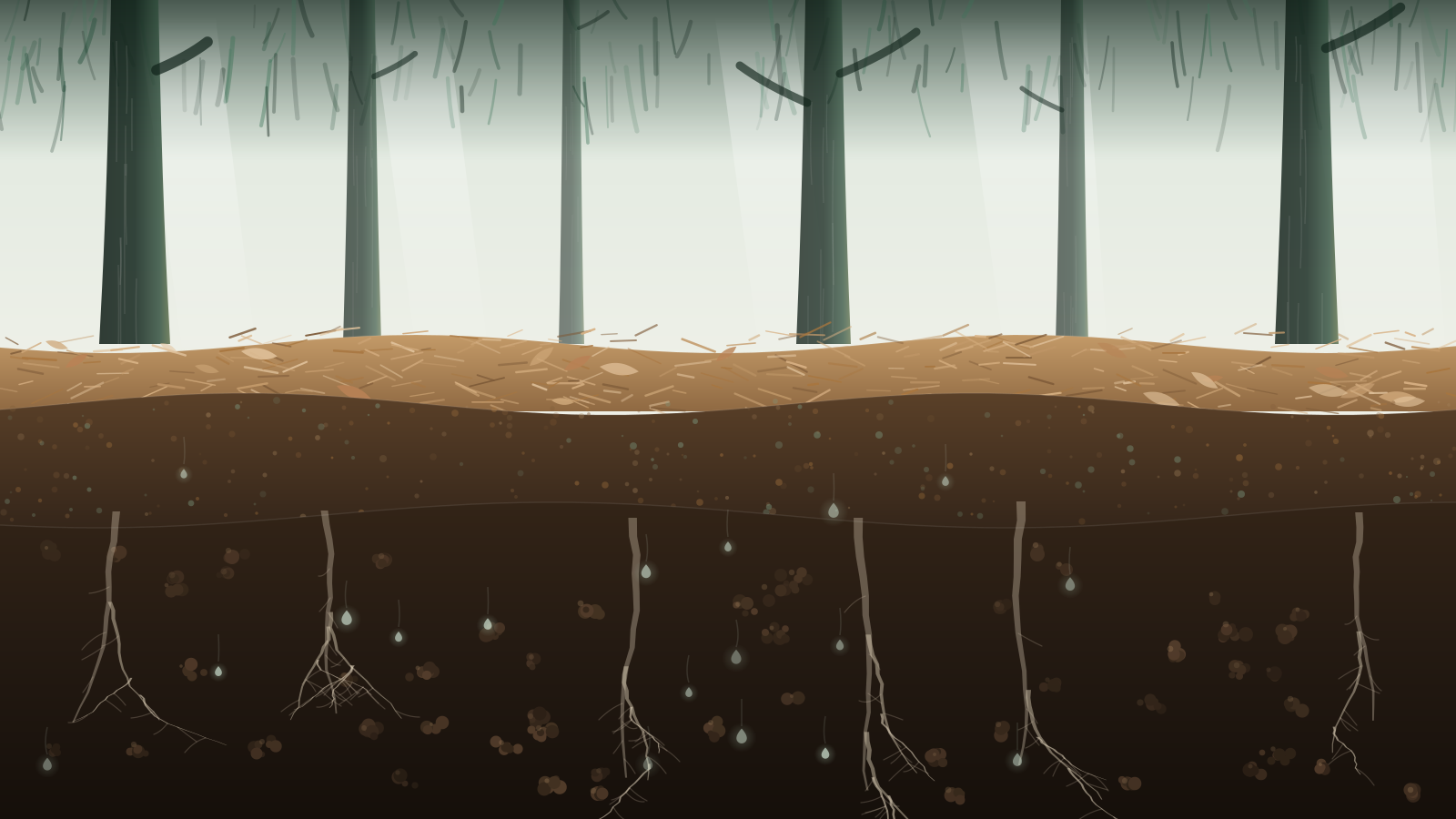
On a forest floor, nothing sits still. Organic matter is continuously broken down, rebuilt, dissolved and carried downward to the roots. The soluble fraction is the part of that cycle that travels.
BioBenefits™ is drawn from that stage — not the deposit, but the fraction in transit. It is made from naturally fermented Japanese cedar and hinoki cypress organic matter, extracted with water rather than alkali, and it is a liquid soil conditioner: it is not a fertilizer and is not sold as plant food.
A note on the word “humic”
“Humic acid” is an operational definition rather than a molecule. It names the fraction of soil organic matter that dissolves when you treat it with alkali and comes back out of solution when you acidify below roughly pH 2. “Fulvic acid” names the part that stays in solution. These are categories defined by the extraction procedure used to isolate them.
Alkali is used because it dissolves a great deal. Water dissolves considerably less. But what water dissolves is, by definition, the part that was already mobile at something close to the pH a soil actually runs at — which is precisely the fraction that interested us.
Where the line is
What we don't claim
Three things we will not tell you
That this is forest soil. Forest soil contains thousands of organic compounds, microbial metabolites, enzymes, trace organic acids and living organisms. Nobody has fully characterized it — so nobody can honestly say they've bottled it. BioBenefits™ is not a replica of forest soil, and we won't describe it as one. It is a product informed by how that system works.
That it replaces feeding your crop. It is a liquid soil conditioner. It works on the conditions in which nutrients are held, released and reached. If your soil is genuinely short of a nutrient, it will still be short of that nutrient.
That Japanese soil is somehow special. We're not claiming Japanese soil is different, or better, or chemically unique. We're saying that tending a landscape for centuries teaches you where to look.
There is also a fourth: numbers. Performance figures belong with the data behind them, so this page carries none. [LEARN-01] Trial or field data to cite here, if and when it exists — site, crop, seasons, method, what was measured. Until then this paragraph stands as written.
We'd rather tell you where the line is than sell you past it.
Where next
So: which part of this is your problem?
A raised bed, a hundred acres, a shelf or a production line each meet the same soil questions at very different scales. Start from the one that's yours.