For commercial growers
An input that goes down the line you already run.
BioBenefits™ is a liquid soil conditioner supplied in volume formats for fertigation and injection. This page covers what it is meant to do, whether it will run through your equipment, what it costs per acre, and what evidence exists — including where it doesn't yet.
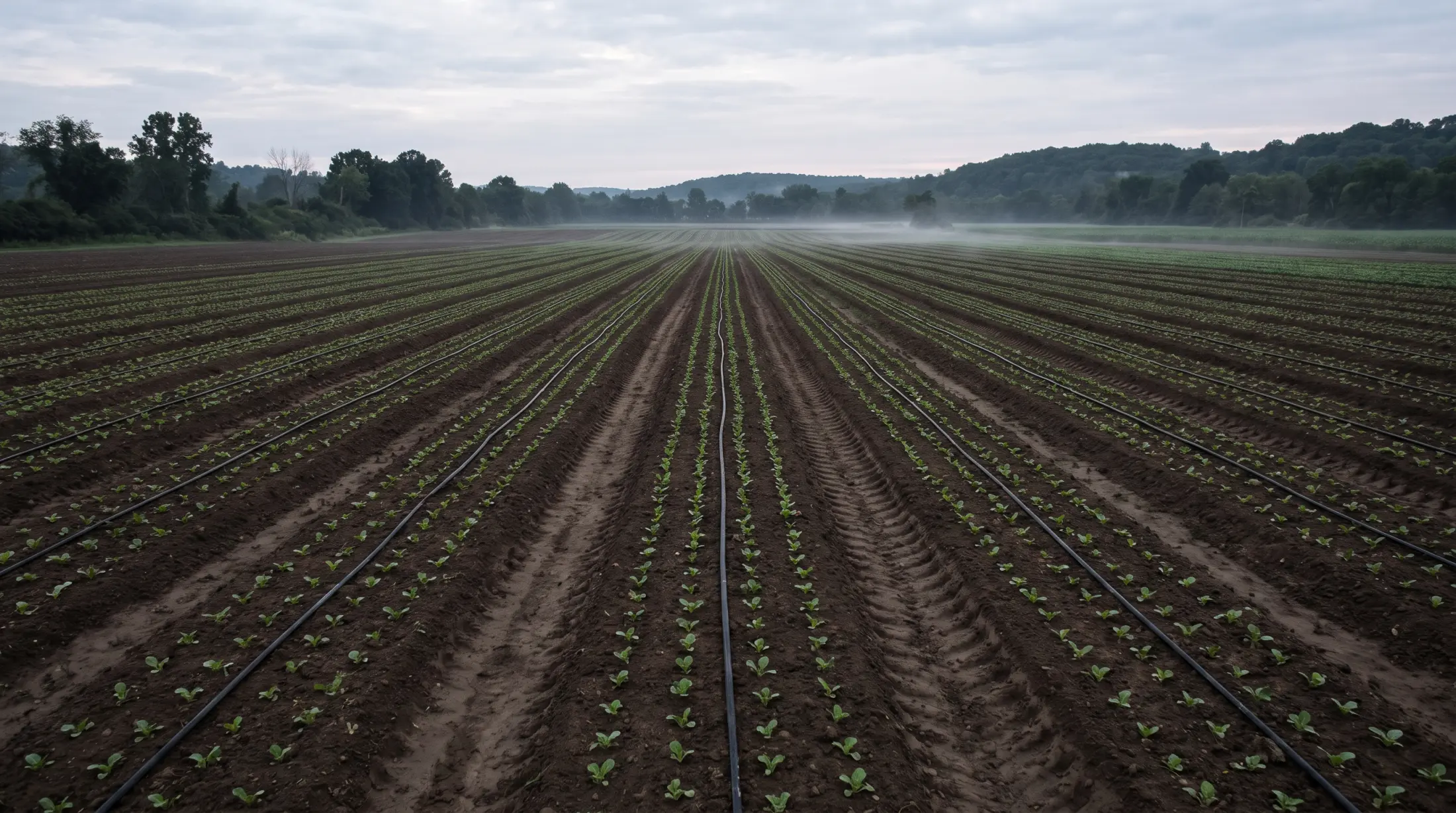
Why BioBenefits
Three reasons that hold up at field scale
Organic matter does a small number of specific jobs in soil. Each of them costs you money when it isn't happening.
Retention, where inputs are lost
Humic substances carry carboxyl and phenolic groups that are negatively charged at soil pH. They hold the cations you paid for — potassium, calcium, magnesium, ammonium — against the water moving past them. On sandy ground, on high-leaching soils and under heavy irrigation, that is the loss you can actually do something about.
This raises the soil's ability to hold nutrients. It does not supply them. Your fertility program stays as it is.
Aggregate structure and infiltration
Organic matter binds clay, silt and microbial products into aggregates. Aggregated soil takes water in faster and holds more of it between events — which is the difference between a rain that infiltrates and a rain that runs off a compacted furrow, and between irrigating on schedule and irrigating to catch up.
Habitat for the biology you already rely on
Bacteria and fungi need carbon and somewhere to live, not fertilizer. Soil biology is what actually cycles residue, mineralises nitrogen and moves phosphorus. Feeding the crop does nothing for it; organic matter is what it lives in.
What that is worth on your operation is a separate question
Everything above is established soil science, not a claim about your fields. Whether it changes a number you care about depends on your soil, your water and what you're growing. We would rather you find that out on a strip than take our word for it — what we can and can't show is set out below.
[FARM-01] Agronomic and regulatory sign-off required on the language in this section. Every performance statement on this page needs substantiation on file before launch, and soil conditioner claims are governed state by state.
Equipment
Will it run through what you have?
The first question every grower asks, and the one worth answering before anything else. Below is what we know and what still has to be confirmed.
| Physical form | Liquid concentrate, water-soluble. It is diluted and applied to the soil. |
|---|---|
| Injection / fertigation | [FARM-02] Confirm compatibility with common injector types — venturi, piston, diaphragm, electric dosing — and the injection ratio range supported. |
| Drip & micro-irrigation | [FARM-03] Confirm behaviour through drip tape and emitters: filtration required, minimum screen or disc mesh, and whether any residue or biofilm risk has been tested. |
| Overhead & pivot | [FARM-04] Confirm suitability for centre pivot and solid-set application, and the water volume range it should be applied in. |
| Ground application | [FARM-05] Confirm whether broadcast, banded, in-furrow or side-dress application is supported, and any equipment notes for each. |
| Foliar | [FARM-06] The product is aimed at the soil. State plainly whether foliar application is supported at all. |
| Tank-mix compatibility | [FARM-07] Compatibility matrix needed — UAN and other N solutions, phosphates, calcium and micronutrient chelates, common adjuvants and crop protection products. Include the combinations where it fails; growers will find those anyway. |
| Jar test | We recommend a jar test with your own water and your own tank partners before the first full run. [FARM-08] Supply a one-page jar-test protocol, including order of addition. |
| pH & EC of the diluted solution | [FARM-09] pH and EC of the concentrate and at the intended dilution. |
| Storage & handling | [FARM-10] Shelf life, temperature range, freeze/thaw behaviour, whether agitation is needed after standing, and container handling notes for drums and totes. |
| Documentation | Specification sheet, SDS and a certificate of analysis per lot are available on request. [FARM-11] Confirm which of these can be sent today and attach the PDFs. |
Rates & cost
Cost per acre, per application.
That is the number that decides this, so we will not bury it or quote a per-gallon price and let you do the arithmetic.
We are not publishing a rate or a price until both are final and match the approved label. Anything you see here as a marked box is genuinely not settled yet — ask us and you will get the current figure with the assumptions attached.
| Application rate | [FARM-12] Rate per acre per application. Must match the approved product label exactly. |
|---|---|
| Dilution | [FARM-13] Injection ratio and finished water volume per acre. |
| Applications per season | [FARM-14] Number and timing — pre-plant, at planting, through the season. |
| Cost per acre per application | [FARM-15] Cost per acre at each volume tier. |
| Season cost per acre | [FARM-16] Full-season cost per acre at the recommended program. |
| Crops | [FARM-17] Crop groups the label covers, and any crop-specific rate differences. |
| State registration | In progress — not yet complete. Soil conditioner registration is granted state by state and ours is still under way. We will not ship into a state that has not cleared. [FARM-18] Keep the cleared-state list and expected timings current; sales must be able to answer this on the call. |
Products
Formats for acreage
One retail size is confirmed today. The volume formats below are the shapes we are working towards — sizes, coverage and pricing are being finalised, and none of the figures below are settled.
Drum
The working format for a single block or a first season on part of the operation.
- Container[FARM-19] drum size
- Covers[FARM-20] acres per drum at the label rate
- Price basis[FARM-21] price and volume tier
Tote
Bulk delivery for whole-farm programs, drawn down through the season against a scheduled refill.
- Container[FARM-22] tote / IBC size and whether it is returnable
- Covers[FARM-23] acres per tote at the label rate
- Price basis[FARM-24] price and volume tier
Trial quantity
Enough to run a strip against an untreated check before you commit a program to it. Built on the retail pack, which is the one size that exists today.
- Unit32 fl oz (946 ml), Multi-Purpose Formula
- Supplied as[FARM-25] units per case, or a dedicated trial pack size
- Price basis[FARM-26] trial pricing, and whether it is credited against a first order
Pack formats for farm supply are being finalised. The 32 fl oz Multi-Purpose Formula retail bottle is the only confirmed size; drum and tote specifications, coverage figures and pricing are not settled and are shown here as placeholders rather than as offers.
| Minimum order | [FARM-27] Minimum first order and reorder minimum, by format. |
|---|---|
| Lead time | [FARM-28] From US stock versus made to order, and what changes in the spring peak. |
| Delivery | [FARM-29] Freight terms, delivery to farm versus depot, pallet configuration, whether a lift gate or forklift is required at the receiving end. |
| Booking a planting window | [FARM-30] How far ahead an order has to be placed to land inside a planting window, and whether volume can be reserved on forecast. |
| Payment terms | [FARM-31] e.g. Net 30 on approved credit, prepay discount, seasonal dating. |
Evidence
What we can show, and what we can't
You have been sold soil products before. Here is the honest position, stated before you ask for it.
We do not promise a yield response
Nothing on this page claims a bushel, a box or a percentage. A soil conditioner works on the soil's ability to hold and cycle what you put in it. Whether that shows up in a yield figure depends on whether retention or structure was limiting you in the first place, and on a season you don't control.
The mechanisms are not in dispute
Cation exchange from humic substances, organic matter's role in aggregate stability, and the dependence of soil biology on organic carbon are standard soil science. What is specific to us is the source and the extraction, not the mechanism.
Our own trial data
[FARM-32] List the trials that exist: crop, location, year, design, whether replicated, and what was measured. If the honest answer is that field trial data is limited, say that here rather than omitting the section.
Third-party and university work
[FARM-33] Any independent trial, university evaluation or published analysis available for release, with the report attached. If none, state that and say what is under way.
Leave a check strip
The only evidence that will convince you is your own. Treat part of a field, leave an untreated strip through the same soil type on the same irrigation set, and measure whatever you already measure. We will help design it and we will not ask to approve the result.
[FARM-34] Confirm what agronomic support is genuinely available — who visits, how often, and whether soil sampling before and after is offered or paid for.
How it proceeds
From first call to delivery
Five steps, and the first two cost you nothing.
-
Tell us the operation
Acres, crops, soil types, irrigation method and what your current fertility program looks like. That is enough for us to say whether this is worth your time.
-
Documentation and a jar test
Specification sheet, SDS and a sample so you can jar test it against your own water and tank partners before anything goes in a line.
-
Strip trial
A treated block against an untreated check, at [FARM-35] trial quantity and acreage. Run it on ground you know well.
-
Program and delivery window
Volume, format and a delivery date set against your planting window rather than our production schedule. Registration status for your state is confirmed in writing before an order is accepted.
-
Season supply
Scheduled deliveries against forecast, with a certificate of analysis per lot.
Questions
What comes up on the first call
Will it increase my yield?
Will it plug my emitters or blind my filters?
Can I run it with my UAN and micronutrients?
What does it cost per acre?
Does it replace any of my fertilizer?
Is it registered in my state?
Is it approved for organic production?
Can I get it in time for planting?
How is this different from the humic acid I already buy?
Who do I call when something goes wrong mid-season?
Next step
Tell us the acres and the irrigation.
We'll come back with registration status for your state, the current rate and cost per acre, a compatibility answer for your tank, and a trial quantity you can put on a strip.