For formulators & manufacturers
An input you can specify, document and plan around.
HS-2® PRO is supplied in bulk as a water-soluble organic fraction for use in finished soil amendments, liquid feeds, growing media and specialty horticultural products — with the specification, certificates and supply commitments a production schedule requires.
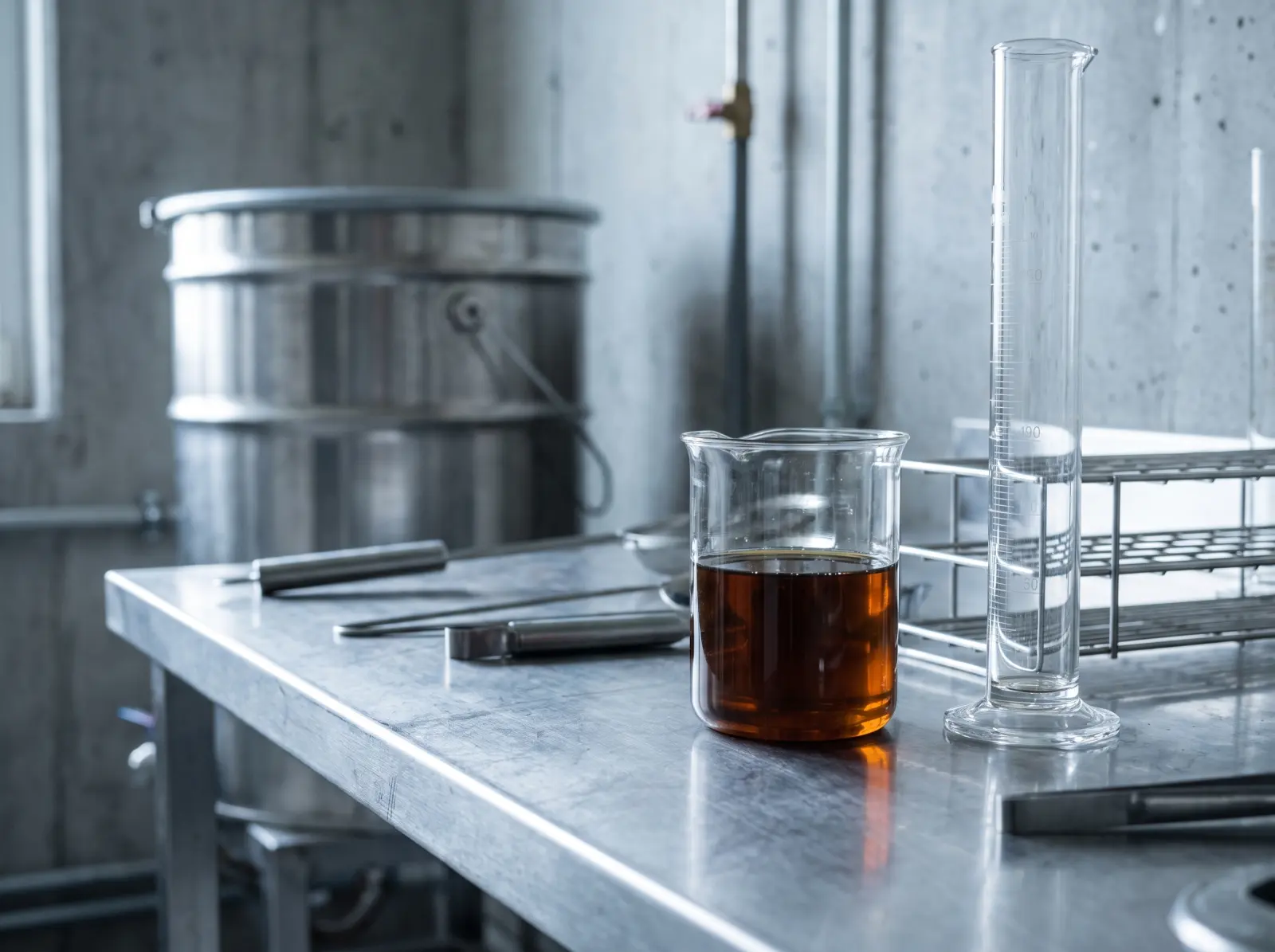
Why formulators look at it
Four practical reasons
Water-soluble by origin, not by processing
HS-2® PRO is the water-extracted soluble fraction of naturally fermented forest organic matter. It isn't a mined humate redissolved with alkali, which is the usual route into a liquid formulation.
[MFG-01] Add the formulation consequences you can substantiate — solution clarity, sediment behaviour, pH of the concentrate, whether pH adjustment is needed to keep it in solution.
Documented and lot-traceable
Specification sheet, SDS and a certificate of analysis per lot, so your incoming QC and your own label claims rest on something.
[MFG-02] List the analytes reported on the COA and the methods used. Buyers will compare method as closely as value — humic/fulvic figures are method-dependent.
A brand story you can license into your label
Most raw materials give you a percentage to print. This one gives you Japanese forests, Satoyama and a genuinely different process — a differentiator for your finished product, not just ours.
Supply built for production planning
Bulk formats, forecast-based scheduling and honest lead times, including what changes during peak season.
[MFG-03] State current production capacity and whether US-side inventory is held.
Where it goes
Product categories it's suited to
The material is a soluble organic fraction, so it belongs wherever organic matter functionality has to travel in water.
Liquid soil amendments & conditioners
As the functional base or as a component alongside other inputs.
Liquid fertilizers & feed programs
Where nutrient retention and soil conditioning are part of the product proposition. [MFG-04] compatibility with high-salt NPK solutions
Growing media & potting mixes
Incorporated at blending, or as a charge applied to the finished mix. [MFG-05] confirm which
Turf & landscape programs
Professional applicator concentrates and fertigation. [MFG-06] confirm suitability for injection systems
Specialty & hydroponic
[MFG-07] Confirm whether recirculating systems are supported. Organic fractions in hydro can cause biofilm/clogging concerns — answer honestly.
Private label finished goods
Your brand, your pack, our material and documentation. See below.
Supply
Formats, minimums and lead times
| Bulk formats | [MFG-08] e.g. 5 gal pail / 55 gal drum / 275 gal IBC — with net weight per unit |
|---|---|
| Minimum order quantity | [MFG-09] trial quantity and production quantity |
| Lead time | [MFG-10] from stock vs. made-to-order; ocean transit if shipped from Japan |
| Incoterms / ship point | [MFG-11] e.g. FOB Japan, DDP US warehouse |
| Pricing basis | [MFG-12] per unit / per lb / per gal, volume tiers, contract pricing availability |
| Annual capacity | [MFG-13] |
| Shelf life & storage | [MFG-14] shelf life, temperature range, freeze/thaw tolerance, agitation requirement |
| HS / tariff code | [MFG-15] HTS classification used at US import |
| Manufacturing site | [MFG-16] location and any facility certifications (ISO, GMP, JAS) |
Documentation
What we send with an inquiry
If a document below isn't yet available, we'll tell you that rather than promise it. Nothing here should be a surprise at goods-in.
Technical specification sheet
Appearance, solids, organic matter, humic and fulvic content with test method, pH, specific gravity, EC, solubility. [MFG-17] attach final PDF
Safety Data Sheet (SDS)
GHS-format, US English. [MFG-18] confirm SDS exists in US format and is current
Certificate of Analysis, per lot
Issued against the specification with lot number and manufacture date. [MFG-19] confirm analytes and lab
Stability & compatibility data
[MFG-20] Jar-test results, pH stability window, compatibility with common salts and surfactants, microbial stability. This is usually the deciding document for a formulator.
Regulatory support
Composition statements and source documentation to support your own state soil amendment registrations. Registering your finished product is your obligation as the registrant, not ours — worth being clear about early. Our own state registration of HS-2® PRO is in progress and does not carry across to your product. [MFG-21] Confirm exactly which documents you supply for a registrant's filing.
Certifications
[MFG-22] OMRI / NOP input status, organic certification of the raw material, non-GMO, heavy metals screening results
Beyond raw material
Private label and co-development
Ingredient supply
You buy the material and formulate it into your own product line. Standard specification, standard documentation.
Private label
Finished product in your pack under your brand. [MFG-23] confirm availability, MOQ, pack options and whether filling is done in Japan or the US
Co-development
Joint work on a formulation for a specific crop, channel or claim set. [MFG-24] confirm appetite, and IP/exclusivity terms
Using the HS-2® PRO name on your label
Ingredient branding is available — naming HS-2® PRO on your pack, and drawing on the Japanese forest and Satoyama story in your own marketing.
Two conditions, and they aren't negotiable, because they protect your product as much as ours: use of the mark is covered by a written trademark usage agreement, and the claims must stay inside what the science supports. Specifically, no “forest soil in a bottle,” no “Japanese soil is superior,” and no suggestion that the material replicates forest soil. What is fair to say: “inspired by the natural organic matter cycle found in Japanese forests and traditional Satoyama landscapes.”
[MFG-25] Attach the trademark usage guidelines and approved claim language document.
How it proceeds
From inquiry to production
-
Inquiry & NDA
Tell us the product category, target volumes and timeline. [MFG-26] confirm whether a mutual NDA is standard
-
Documentation & sample
Spec sheet, SDS and a lab sample for your own jar tests and bench work. [MFG-27] sample size and whether free
-
Formulation & trial
Your bench trials, with our technical support on compatibility questions. Pilot-scale quantity available at [MFG-28] trial MOQ.
-
Commercial terms
Volume pricing, supply agreement, forecast schedule, and trademark usage terms if you're naming the ingredient.
-
Production supply
Scheduled deliveries against forecast, COA per lot.
Technical questions
What comes up in the first call
How does this compare analytically to a leonardite-derived humic acid?
Is it stable in a concentrated NPK solution?
What's the pH of the concentrate, and does it need adjusting?
Is it preserved? What's the microbial stability?
Can we make claims about soil structure or nutrient retention on our label?
Who owns the registration for a private label product?
Is supply exposed to a single site or a single raw material source?
Next step
Get the specification and a sample.
Tell us the product you're building and the volumes you're planning, and we'll send the technical pack plus a bench sample.